

The Engineer's Mindset
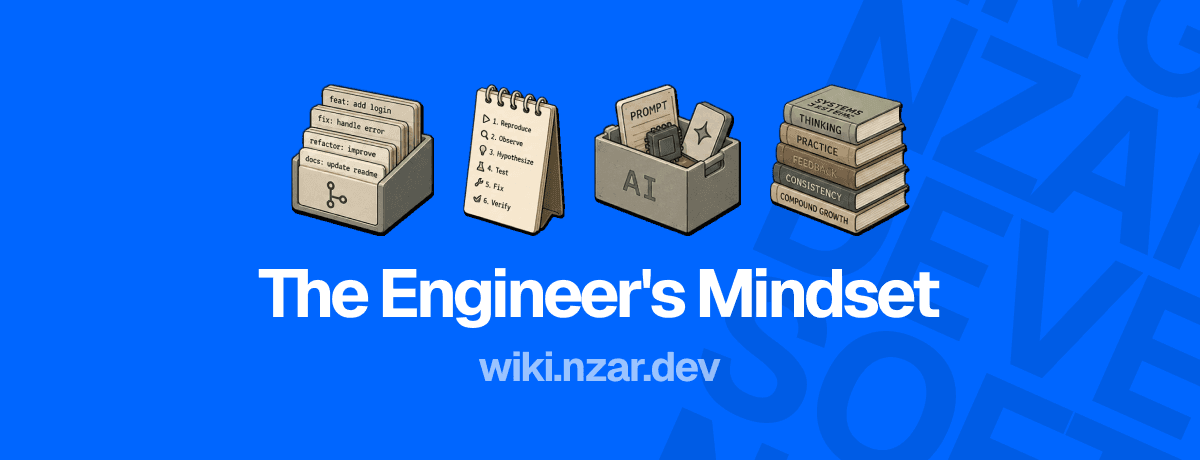
You can memorize every keyword in a language and still freeze the moment something breaks. You can watch a hundred tutorials and still not know where to even start on a blank problem. That gap isn't a knowledge gap. It's a mindset gap, and almost nobody teaches it directly.
Syntax is the easy part. You can look up how a for loop works in ten seconds. What you can't look up in ten seconds is how to break a messy, real-world problem into pieces small enough to actually solve, or how to read an error message and know exactly where to look next, or how to search for an answer without wasting an hour on the wrong query.
That's what this part is for.
Why This Comes Before the Code
Most tutorials teach you a language: some brackets, a few keywords, a couple of patterns. Honestly, that part isn't the hard part. You can learn what a for loop does in a few minutes.
What's harder, and what most tutorials quietly skip, is how to actually think your way through a problem you've never seen before. How do you break something messy down into pieces small enough to handle? How do you read an error calmly instead of panicking? How do you even know where to start looking for an answer?
None of this is something you're supposed to already know. It's a set of skills, and like any skill, it's learned slowly, with patience, one small habit at a time. That's what this part is here to walk you through, gently, and without rushing.
What You'll Learn Here
We'll start with the big question hiding behind everything else: what software engineering actually is, underneath the job title. From there, we'll break down problem decomposition, the single skill that turns an overwhelming task into a list of small, doable steps.
Then we'll get practical. You'll learn how to actually read documentation instead of skimming it, how to debug like a detective instead of guessing your way to a fix, and how to read a stack trace without your eyes glazing over. We'll cover how to use AI tools as a lever instead of a crutch, and why version control isn't just "the thing with commits," but a whole philosophy about protecting your work.
We'll talk about what clean code actually means, beyond just "code that works," and how to search for answers efficiently instead of drowning in irrelevant results. And we'll close with something most engineers never think about on purpose: how to build a learning system that keeps compounding, long after you've finished this wiki.
Why This Part Matters
You'll forget most individual syntax details over your career. Languages change, frameworks come and go, tools get replaced. What doesn't go out of date is your ability to decompose a problem, read an error carefully, and know where to look for an answer.
A junior engineer with weak fundamentals but a sharp mindset will out-learn a junior engineer who memorized a framework but freezes at the first unfamiliar bug. This part is what makes every technical chapter after it easier, because you'll actually know how to approach what you're learning, not just absorb it passively.
This is the part that turns "someone who can write code" into "someone who can engineer." Let's get started.
How Everything Works
How a single line of code you write travels down through the runtime, the operating system, and the hardware, before anything actually happens.
Software Engineering
Why writing code is only a small part of the job, and what software engineers actually spend most of their time doing.